
Audit Overview
Your store's untapped revenue potential — and how to unlock it
Why We Created This Audit
We analyzed infinixmobiles.in the same way we've audited 350+ e-commerce stores — looking for the specific gaps between your current experience and what top-performing Consumer Electronics stores deliver. Every finding in this report is a revenue opportunity backed by industry data and competitive benchmarks.
What We Analyzed
- UX & Conversion Design13 findings
- Technology & App StackPlatform + 4 apps
- Industry BenchmarksConsumer Electronics
Pages Analyzed
- Homepage3 findings
- Collection Pages3 findings
- Product Pages (PDP)4 findings
- Cart & Checkout3 findings
 This audit was prepared by Growisto — a CRO-led Website development team behind 167% conversion growth for Atomberg, 46% CR lift for TyresNmore, and 350+ e-commerce projects.
UX & Conversion Findings
Page-by-page analysis with visual comparisons against top Consumer Electronics stores
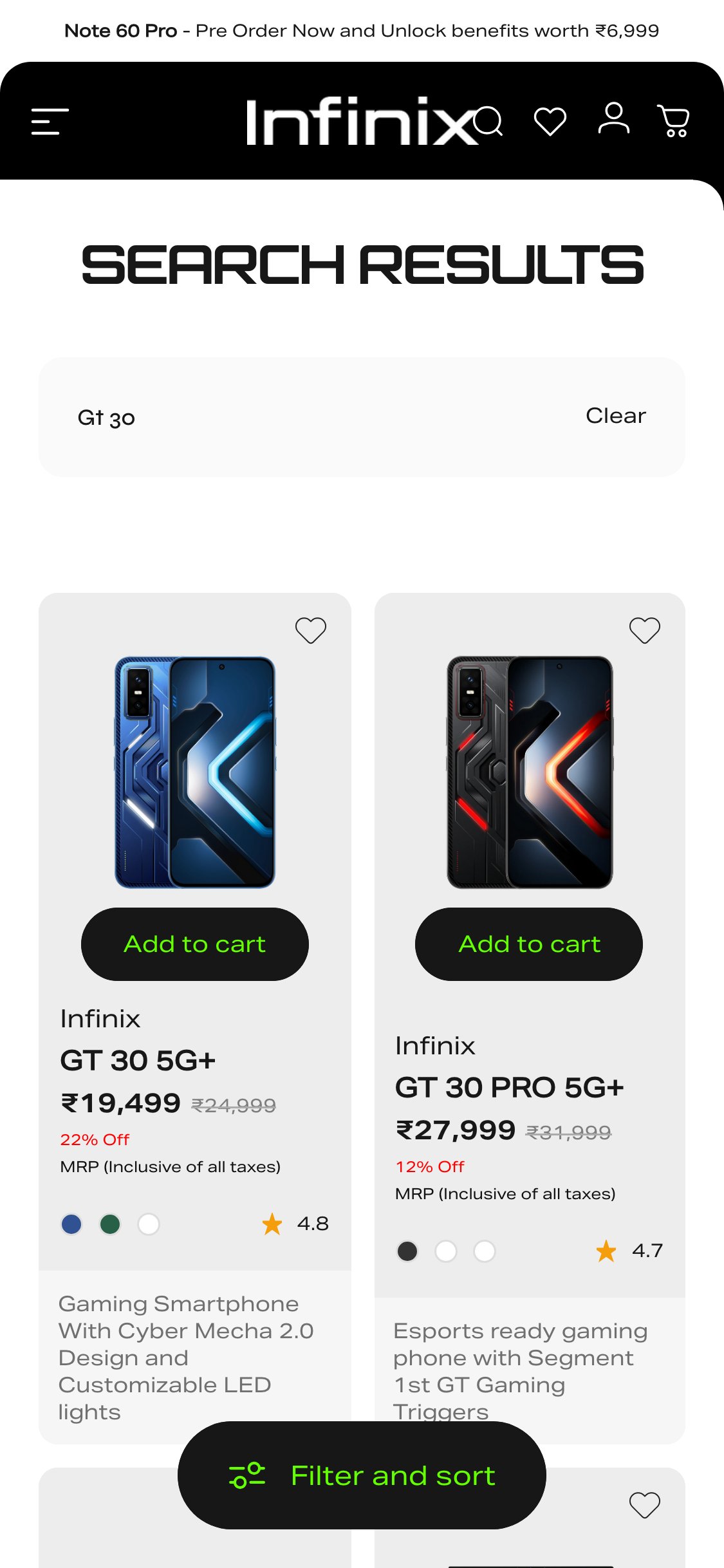
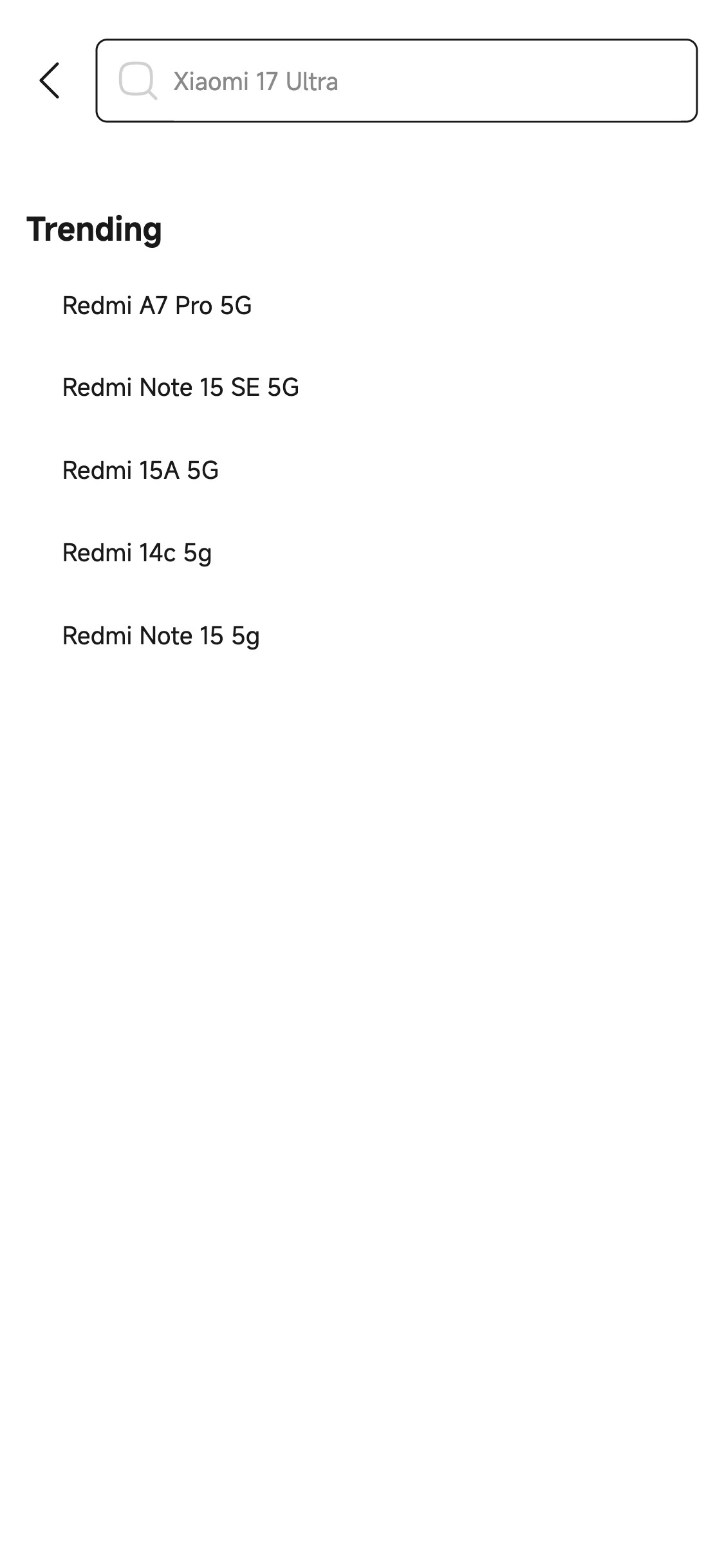
- Tapping the search icon and typing a query (e.g., 'Gt 30') delivers a full search-results page with no dropdown autocomplete suggestions appearing mid-type.
- Without predictive suggestions, users who misspell a model name or type partial terms get no guidance — they either abandon or wade through results manually.
- Competitors Xiaomi India and realme India both show real-time product suggestions with model images and prices as users type, significantly reducing the steps-to-product.
- Search is the highest-intent navigation path — removing friction here directly impacts add-to-cart rates from search-initiated sessions.
- Install a search app (Boost Commerce, Searchanise, or Shopify's native predictive search API) to show model-name suggestions, category shortcuts, and top-product thumbnails as users type.
- Surface the top 5 matching products with model image, price, and discount % in the autocomplete dropdown — no page reload required.
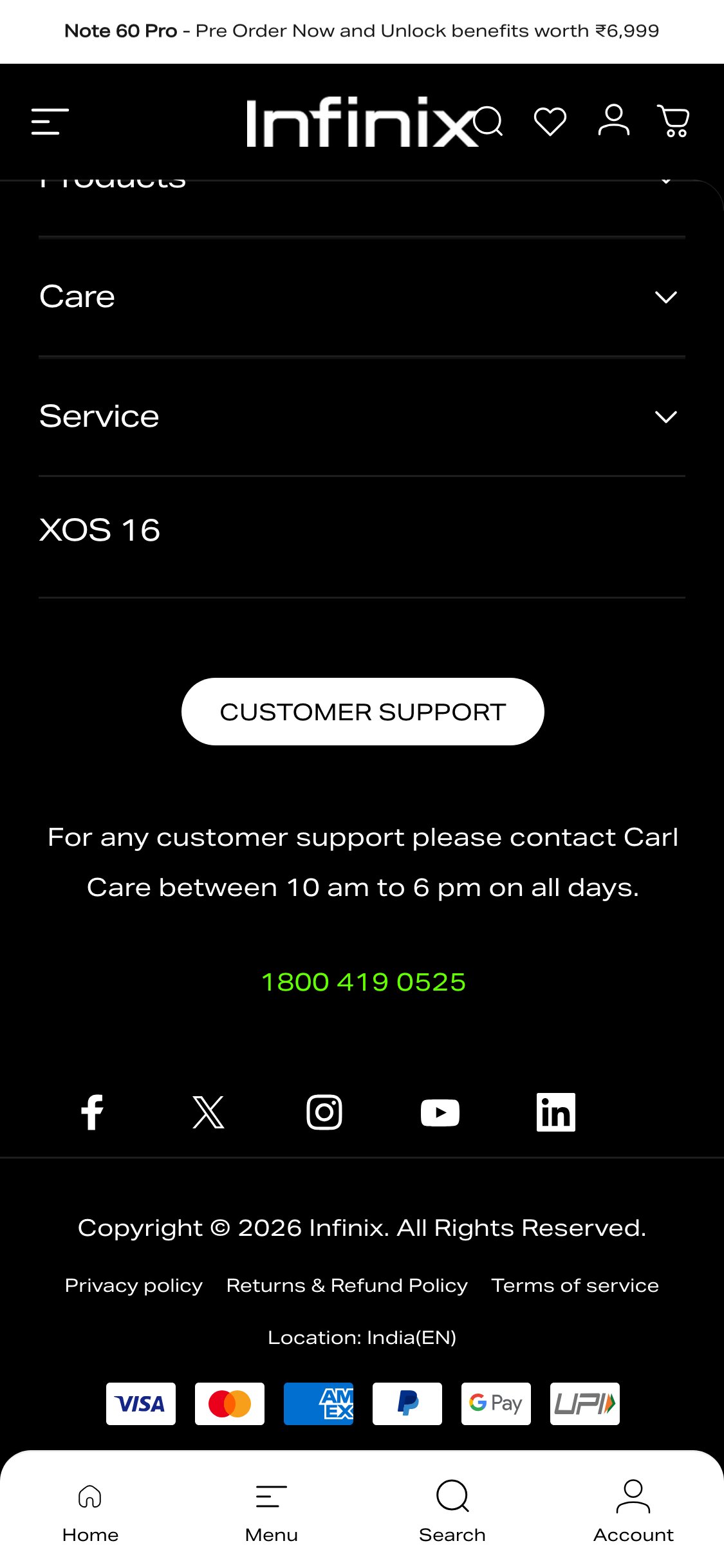

- The footer email field reads 'Subscribe to our email alerts!' with no incentive copy — no discount, no exclusive access, no early launch notification benefit is offered.
- Indian D2C shoppers have high email capture fatigue; without a concrete value exchange (e.g., '₹500 off your first order' or 'Early access to new launches'), submission rates are negligible.
- The footer is also missing a dedicated WhatsApp opt-in, which is the primary re-engagement channel for Indian electronics buyers.
- Add an incentive line below the email field: 'Get ₹500 off your first order' or 'Be first to know about new launches and exclusive deals' — match to Infinix's launch cadence.
- Consider a dedicated WhatsApp opt-in alongside email, given that WhatsApp re-engagement rates in India electronics are 5-8x higher than email open rates.
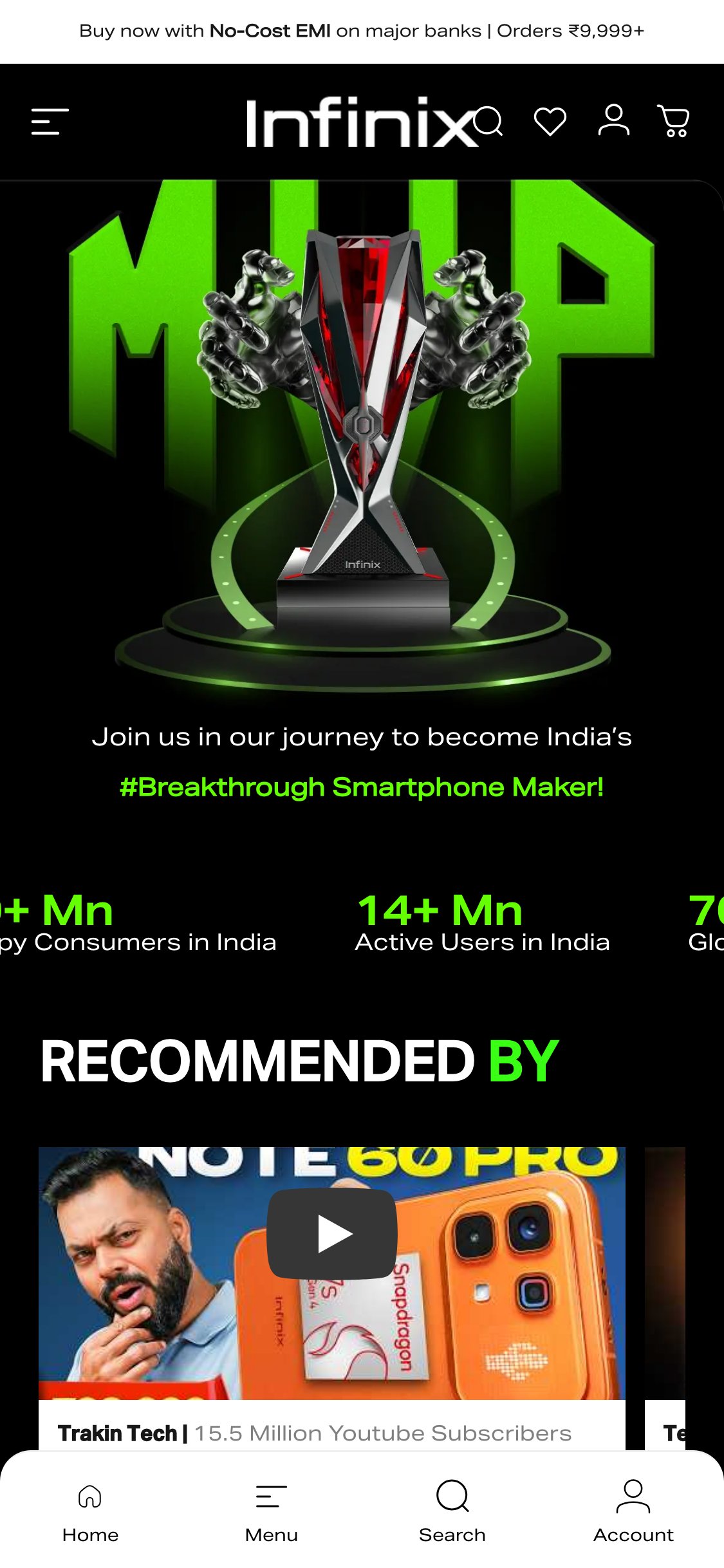
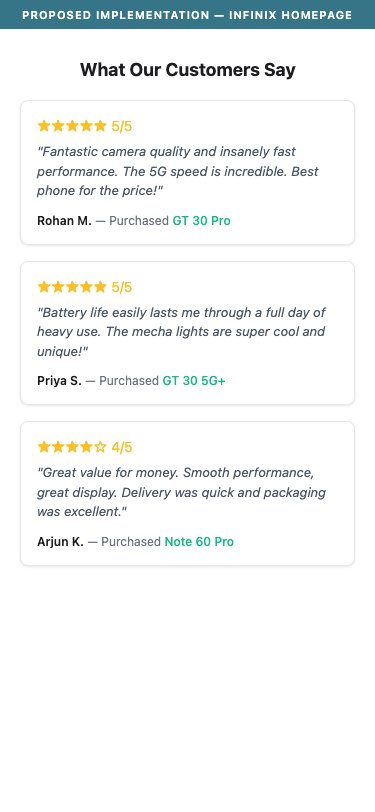
- The homepage features a 'RECOMMENDED BY' section with tech influencer YouTube videos (Trakin Tech, 15.5M subscribers) and brand stats (14+ Mn Active Users in India) — but zero customer review quotes, star ratings, or UGC.
- Influencer endorsements signal reach but not product satisfaction; first-time buyers specifically look for peer reviews from people like themselves before committing to a ₹15,000–₹30,000 smartphone purchase.
- Benchmark data shows 8/10 top electronics stores surface at least a scrolling review strip or 'Most Loved' product section with star ratings on the homepage to build conversion momentum before users reach the PDP.
- Add a 'What Our Customers Say' review carousel pulling the top-rated reviews from the review platform (Judge.me or equivalent) — show star rating, reviewer name, phone model, and review snippet.
- Alternatively, add a 'Most Loved' product row that shows collection cards with review star counts to create social proof at the category-discovery stage.
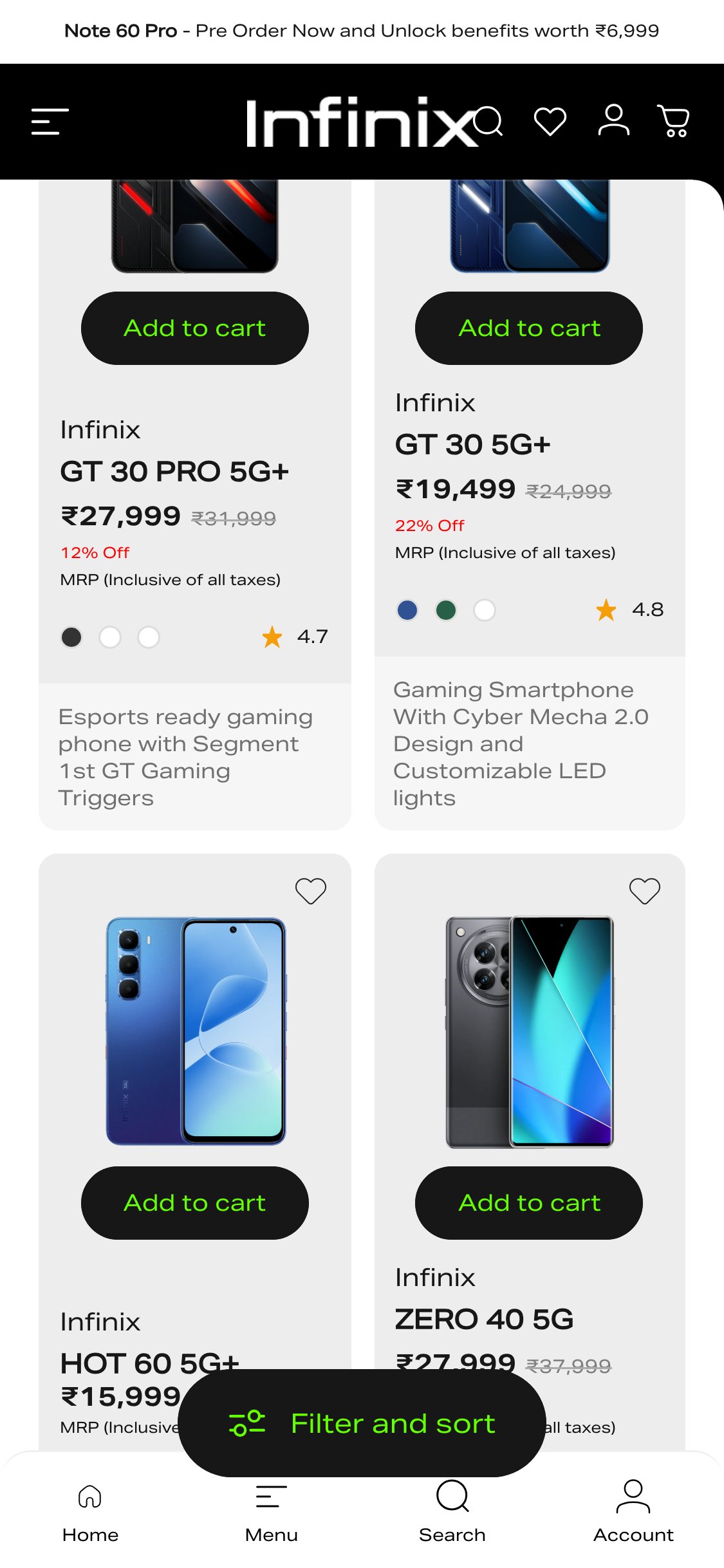
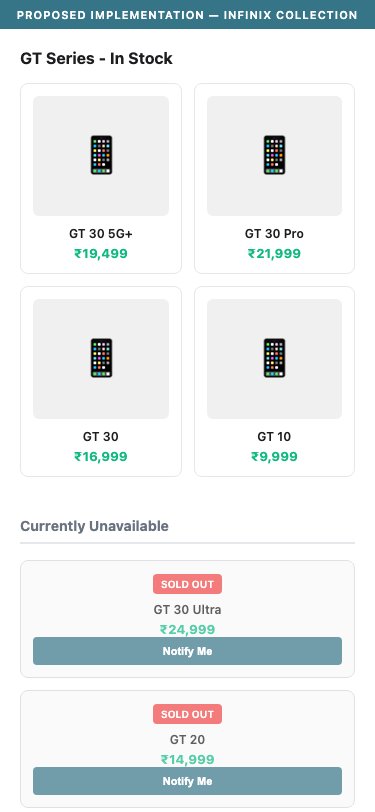
- The collection grid mixes in-stock and out-of-stock products without sorting or visual distinction — shoppers browsing the GT series may encounter unavailable models before in-stock options.
- When a buyer taps an out-of-stock PDP, they hit a dead end with no clear path to an available alternative, increasing bounce rate from collection pages.
- Sorting OOS products to the bottom is a native Shopify feature (inventory-based sort) requiring no development — a settings-level change.
- Enable Shopify's 'push out-of-stock products to the bottom' setting under Online Store > Themes > Collection page sort options — zero development required.
- Additionally, mark OOS cards visually with a 'Sold Out' badge on the collection card thumbnail so shoppers can identify availability before tapping through.
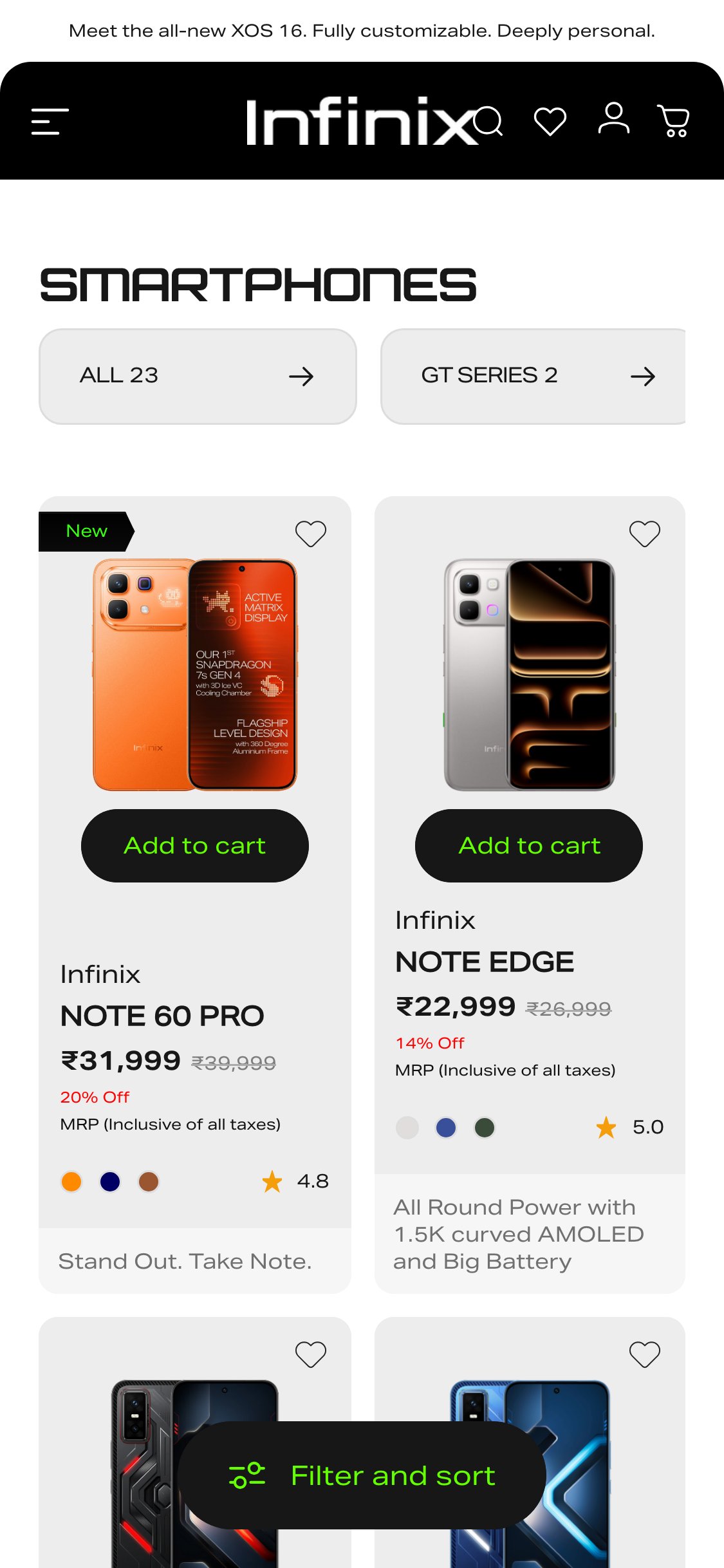
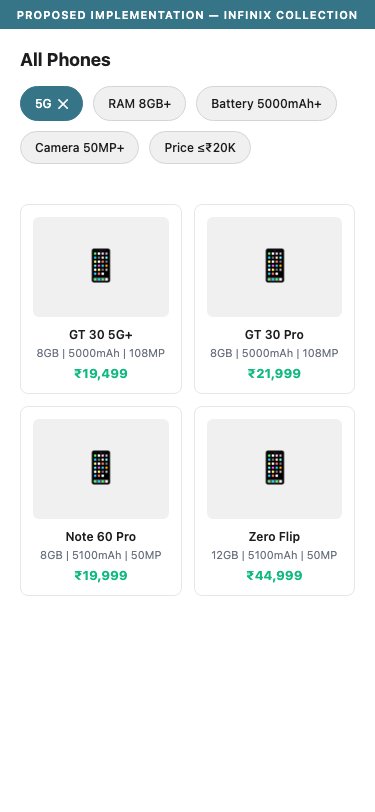
- The collection page has a single 'Filter and sort' floating button with no visible spec filter chips above the grid — users cannot filter by RAM size, battery capacity, camera resolution, price range, or 5G/4G without opening a full filter drawer.
- Smartphone buyers research spec-first; without surfacing filter attributes prominently, Infinix's collection page requires more taps to reach relevant products than competitor collections.
- Xiaomi India and realme India both surface quick-filter chips (5G, 8GB RAM, Under ₹20,000) directly on the collection page header — reducing decision time significantly.
- Surface the top 4-5 filter attributes as horizontal scrollable chips directly below the collection page header: '5G', 'Under ₹20K', '8GB RAM', '108MP Camera', '5000mAh+' — tapping a chip filters in-place.
- Ensure the filter drawer (opened via 'Filter and sort') includes all key spec dimensions: RAM, storage, battery, camera, display size, connectivity, and price range.
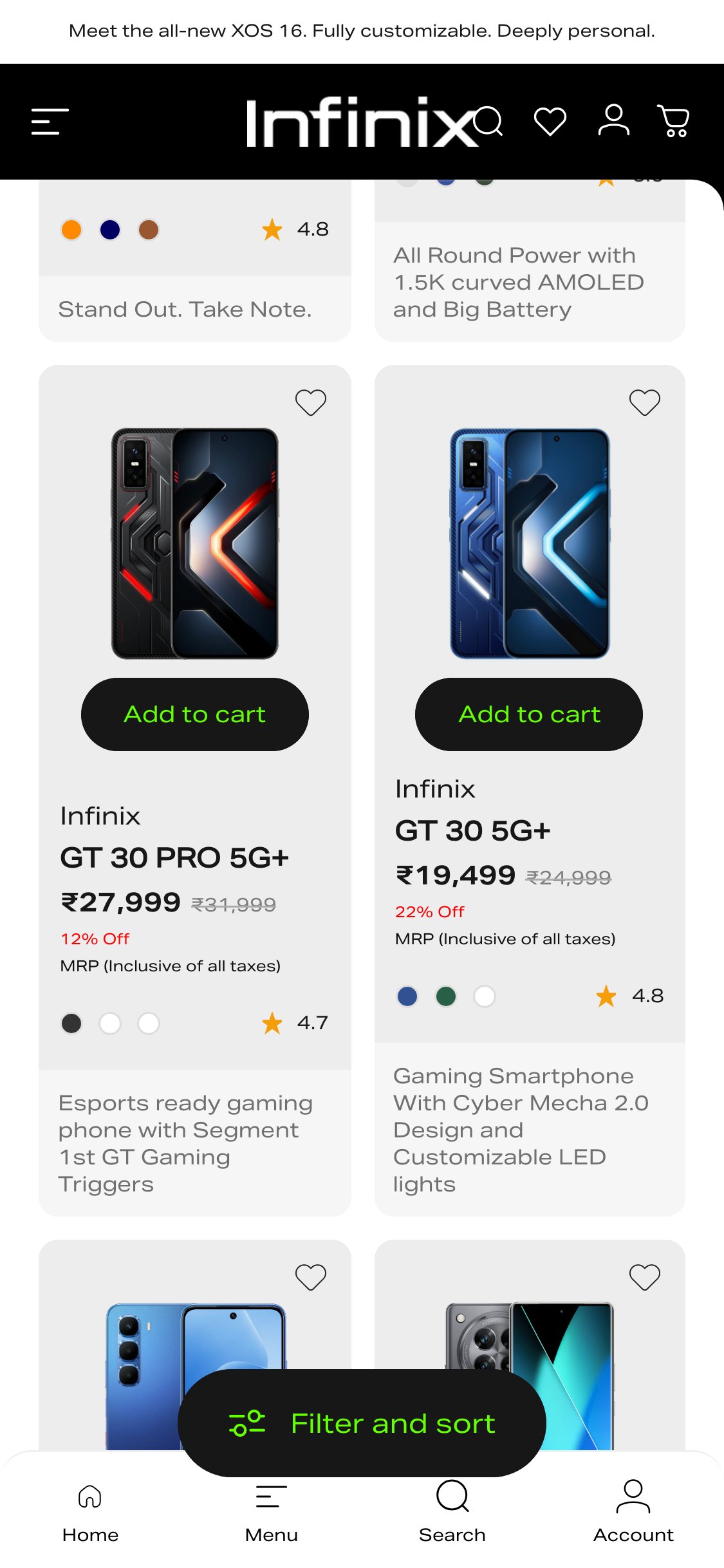
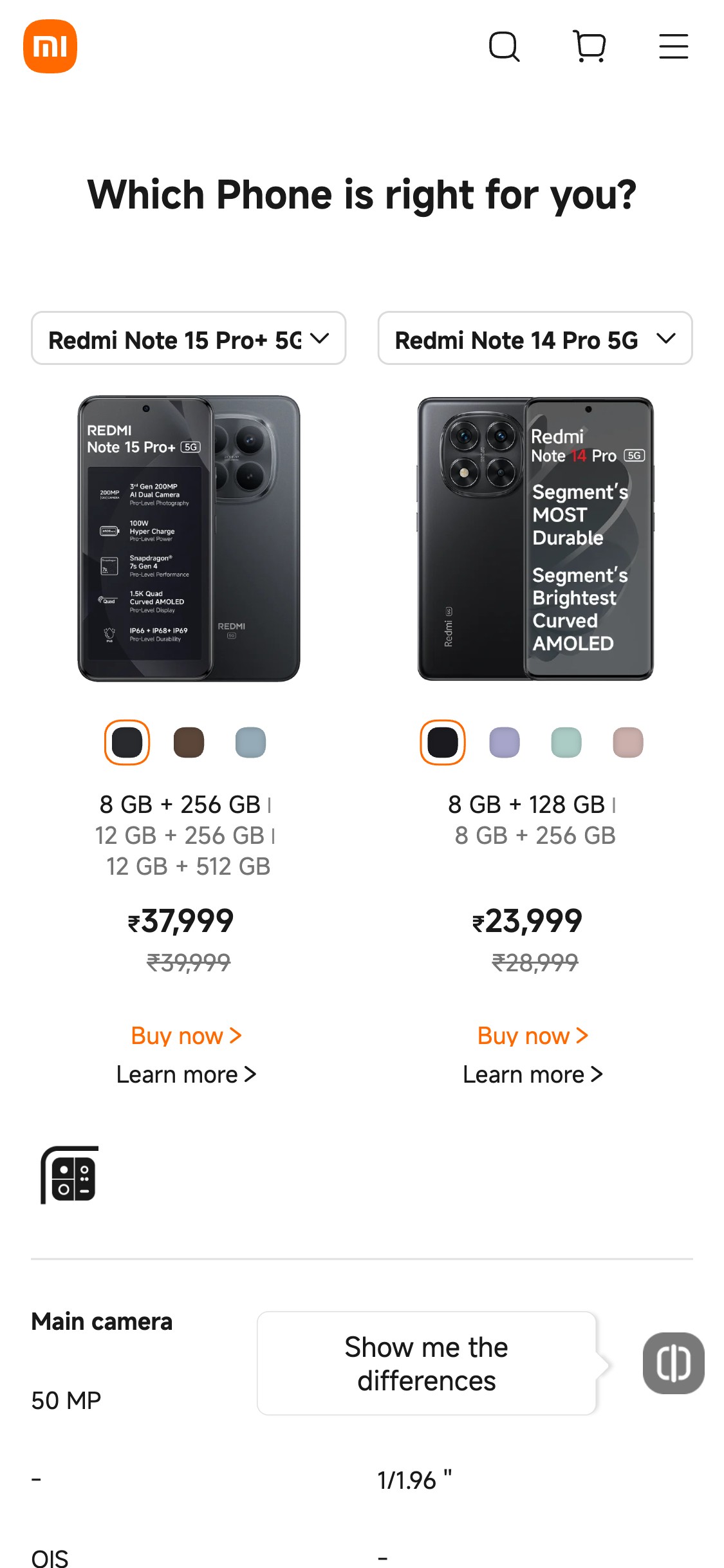
- The collection grid shows no comparison checkboxes on product cards, no 'Compare' CTA, and no side-by-side spec comparison page — buyers who want to evaluate GT 30 vs GT 30 Pro must open each PDP separately and manually compare specs.
- At ₹15,000–₹35,000 AOV, the smartphone category has a longer consideration cycle than impulse categories. Comparison tools directly shorten this cycle by eliminating tab-switching research behavior.
- Xiaomi India has a dedicated 'Compare Mi Phones' tool; OnePlus India shows 'Compare' CTAs on collection cards. Both convert comparison-intent sessions at significantly higher rates than grid-only browsing.
- Add comparison checkboxes to collection cards — when 2-3 are selected, a sticky comparison bar appears at the bottom with a 'Compare Now' CTA leading to a spec comparison table.
- The comparison table should highlight Infinix's differentiators (GT gaming triggers, Mecha lights, battery size) as winning attributes to guide purchase toward the higher-AOV model.
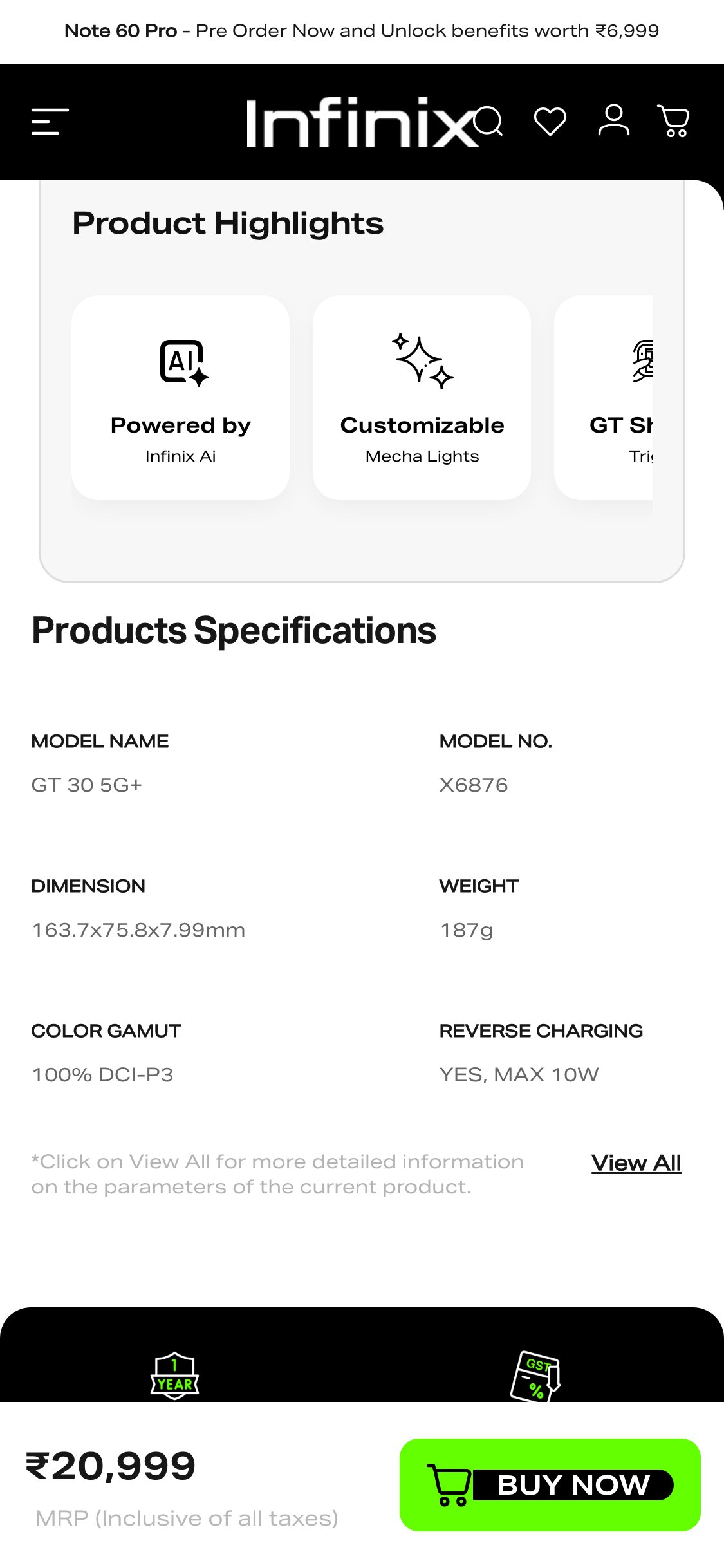
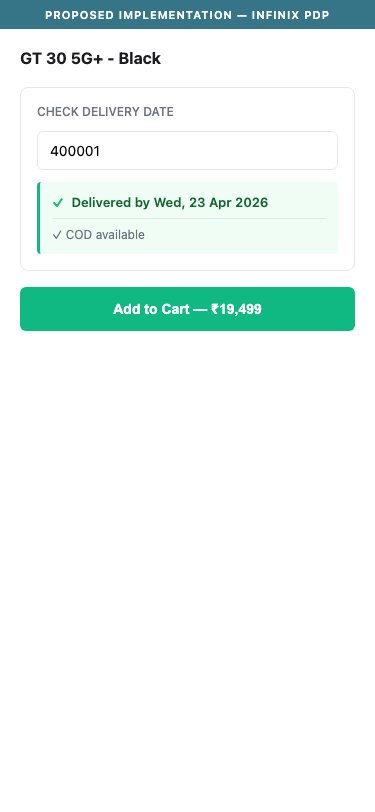
- The PDP mid-section shows Product Highlights icons, a full spec table, and trust badge icons (1-Year Warranty, GST) — but no delivery date estimator or pincode-based delivery timeline is shown anywhere on the product page.
- Smartphone buyers in Tier-2 and Tier-3 India specifically check delivery timelines before purchasing; without this information inline, they navigate away to Amazon or Flipkart to check delivery dates, often completing the purchase there instead.
- OnePlus India and realme India both show pincode-based delivery date widgets ('Enter pincode → Get it by [date]') directly on the PDP between the variant picker and the ATC button.
- Add a pincode-based delivery estimator widget between the variant picker and the ATC/BUY NOW button — input pincode, show 'Get it by [Day, Date]' with the courier partner name.
- Pre-populate with a default estimate for major metros (Mumbai, Delhi, Bengaluru) so users in those cities see a delivery date immediately without needing to enter a pincode.
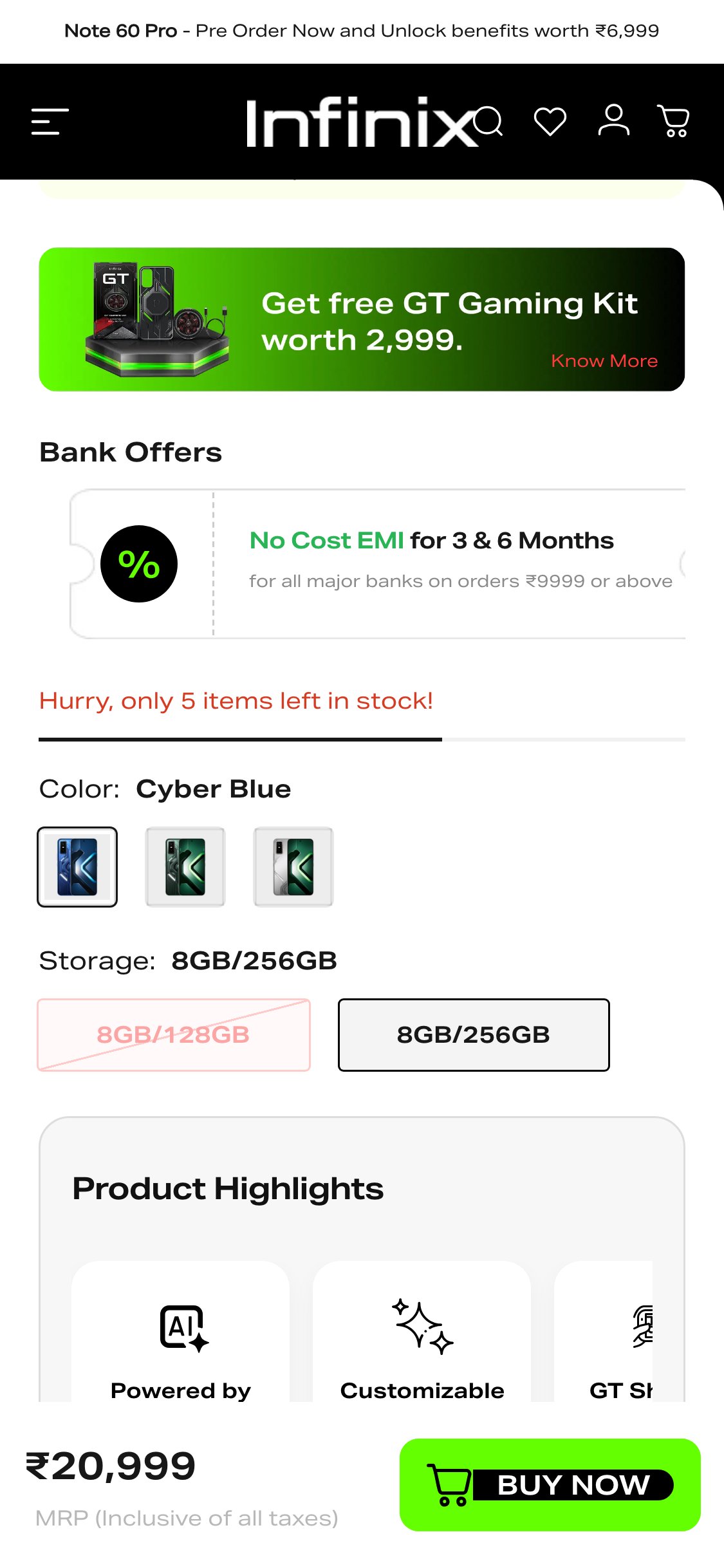
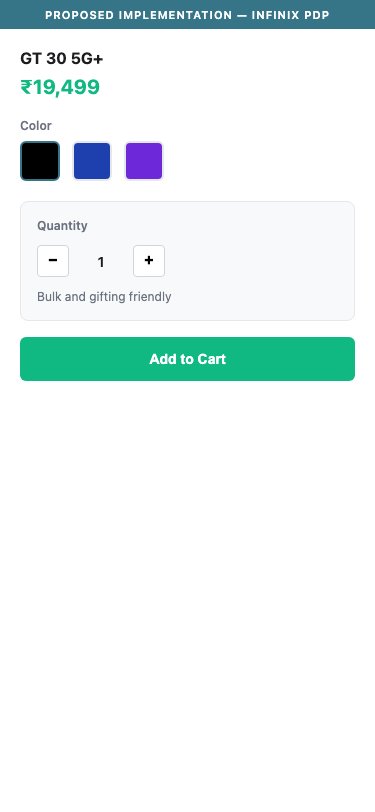
- The PDP shows color swatches, storage variant pills (8GB/128GB, 8GB/256GB), bank offers, and an urgency line ('Hurry, only 5 items left in stock!') — but no quantity selector field before the BUY NOW button.
- While most smartphone purchases are single-unit, corporate and gifting buyers (common during festive seasons for budget smartphones) need to select quantity without visiting the cart to adjust.
- The absence of a quantity selector is a minor UX gap given the category, but adds unnecessary friction for the segment of buyers purchasing multiple units.
- Add a simple +/- quantity selector between the variant picker and the BUY NOW button — default to 1, cap at 5 to match inventory display.
- For the gifting segment, consider a 'Buy for someone' CTA adjacent to the quantity selector during festive periods (Diwali, New Year, Holi) to surface Infinix as a gift option.
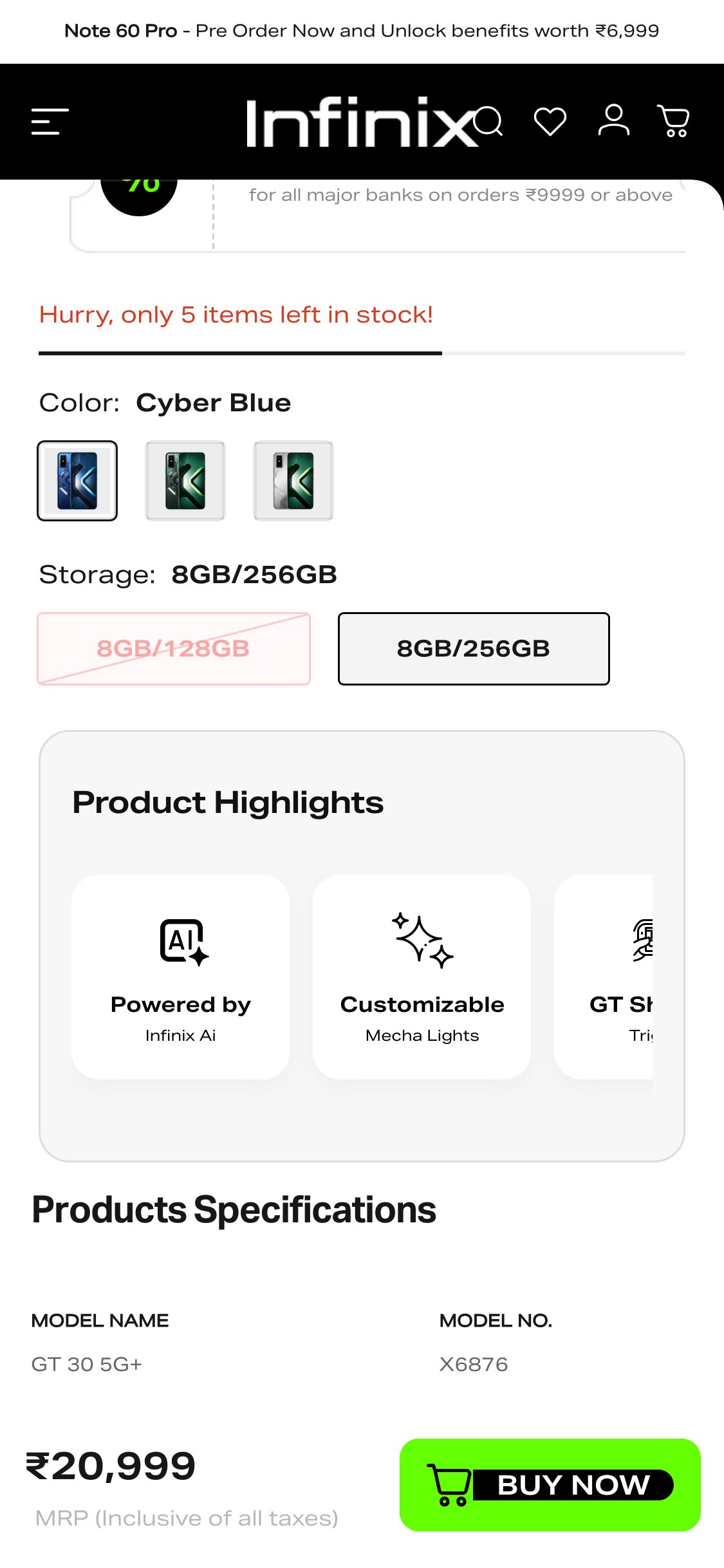
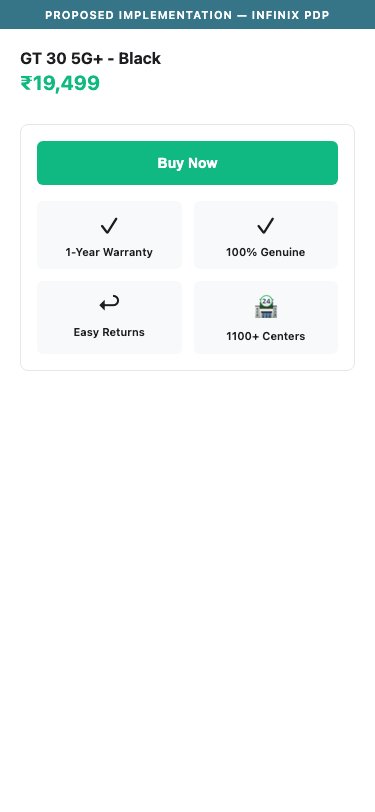
- Infinix's PDP has trust icon tiles (1-Year Warranty, GST Invoice) visible in the mid-page spec section, but they appear below the sticky ATC bar when scrolled — the purchase CTA fires before buyers see warranty reassurance.
- The sticky ATC bar at the bottom of screen shows only price and 'BUY NOW' with no trust signals alongside it — at the exact moment of purchase intent, buyers have no reassurance visible.
- Research consistently shows that trust signals placed within the ATC zone (not just on the page) reduce cart abandonment by reducing last-moment hesitation about warranty and returns.
- Add 2-3 compact trust icons directly inside or immediately above the sticky ATC bar: '1-Year Warranty', '7-Day Returns', '100% Genuine' — use small icon + single-line text format.
- Alternatively, add a trust-badge row (similar to the current mid-page tile grid) directly below the main ATC button in the non-sticky version of the ATC zone, so it's visible when users first reach the purchase area.
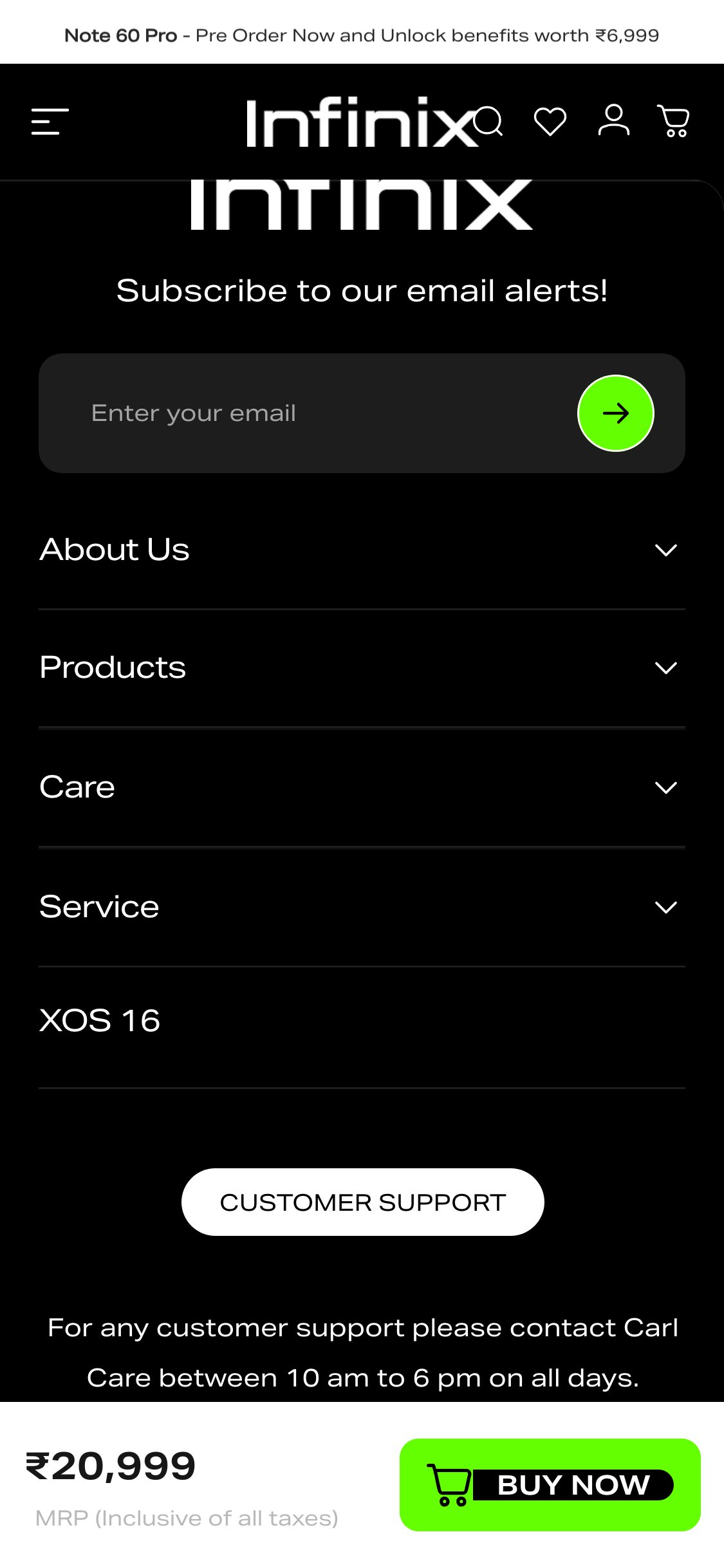
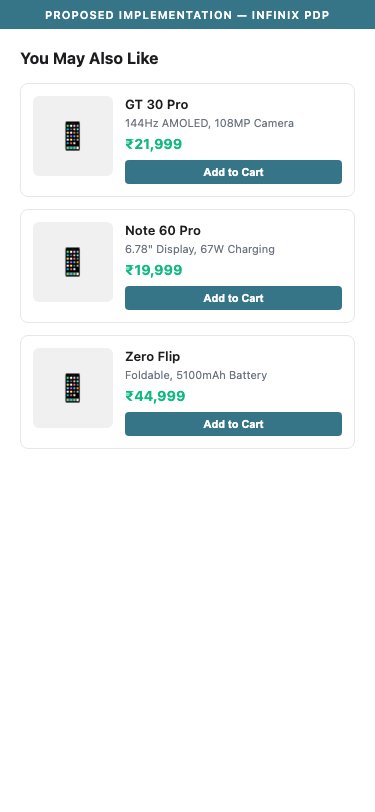
- Scrolling to the very bottom of a Infinix PDP shows the email subscription section and footer navigation — no related products, no 'Frequently Bought Together', no 'Other phones in this series' row is shown anywhere on the page.
- Buyers who land on a specific model PDP but find it out of budget or lacking a desired spec have no guided path to alternatives — they must navigate back to the collection page manually, increasing bounce.
- Smartphone PDPs from Xiaomi India and realme India both show a 'You May Also Like' or series-level comparison row at the bottom of the PDP, keeping buyers in-funnel when the first choice isn't right.
- Add a 'Explore the Series' row above the footer showing 3-4 phones from the same series (GT series, NOTE series) with model image, key differentiating spec, price, and an ATC button.
- For phones with accessories (cases, screen protectors sold via Infinix's Xaccessories line), add a 'Protect Your Phone' cross-sell row — even if linking to external partner pages.

- Attempting to access the cart on mobile triggers a full-screen 'WELCOME TO INFINIX — Signup & Join Infinix' login modal (via krt-app) that blocks the entire cart experience — the popup fires persistently and cannot be scrolled past or dismissed except by closing.
- This modal appears across the site on mobile (homepage, collection, cart) — a new visitor browsing on mobile is interrupted by a login prompt before they can complete any purchase intent action.
- Forcing account creation before cart access is a documented conversion killer: industry data shows 34% of shoppers abandon checkout when forced to create an account. At Infinix's traffic volume, this represents significant recoverable revenue.
- All 8 cart screenshots captured during this audit — across cart drawer and /cart page — were fully blocked by this popup, making it impossible to evaluate any cart features.
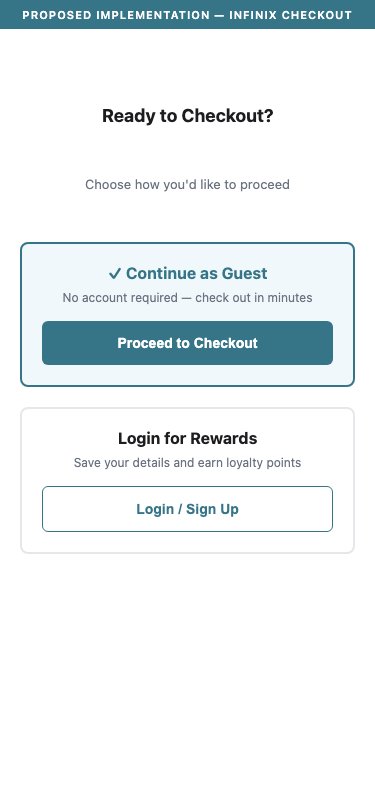
- Disable or restrict the krt-app loyalty popup to only trigger post-purchase (thank-you page) or after a user has added an item to cart AND is about to checkout — never as a blocking modal during browse.
- Implement guest checkout as the default path: account creation should be an optional step offered AFTER purchase is complete ('Save your details for next time'), not a prerequisite.
- If the loyalty program requires an account, gate the loyalty points display only — not the entire cart and checkout flow.
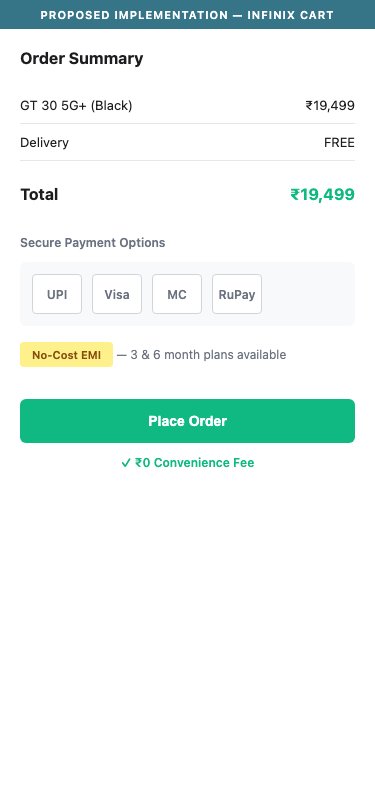
- Infinix's footer shows payment icons (Visa, Mastercard, Amex, PayPal, Google Pay, UPI) — but these are only visible at the very bottom of the page, not near the cart or checkout CTA.
- Indian buyers, particularly first-time purchasers, look for payment method confirmation before committing to checkout — seeing UPI and No-Cost EMI icons at the cart level reduces payment-method anxiety.
- The announcement bar mentions 'Buy now with No-Cost EMI on major banks | Orders ₹9,999+' which is good — but this messaging disappears once the user navigates to cart/checkout, removing the reassurance at the critical commitment moment.
- Add a compact row of payment icons (UPI, GPay, PhonePe, Visa, Mastercard, No-Cost EMI badge) immediately below the checkout CTA button on both the cart drawer and the /cart page.
- Repeat the No-Cost EMI callout ('3 & 6 Month EMI available on orders ₹9,999+') as a 1-line reassurance text beneath the cart total, so buyers see it at the precise moment they evaluate whether to proceed.
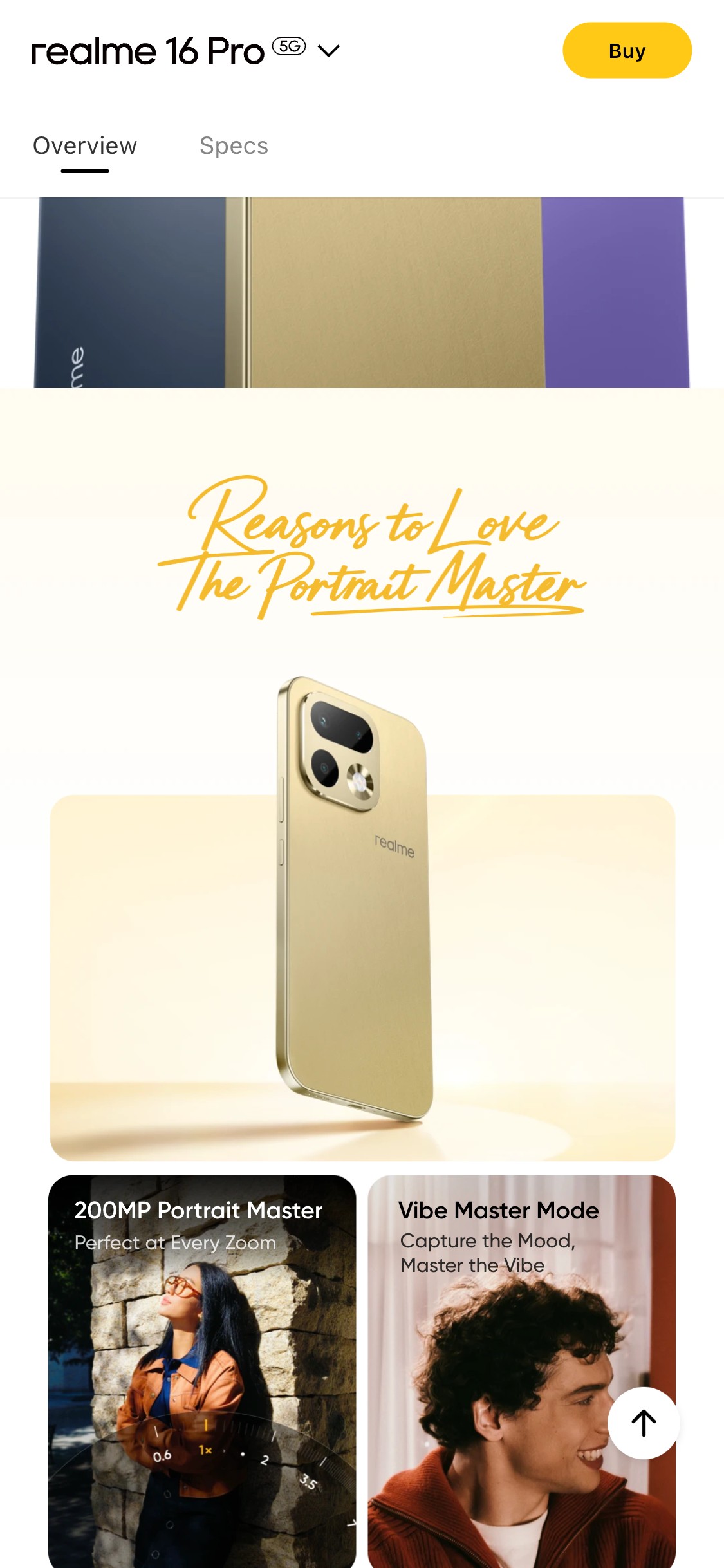
- Infinix offers no phone exchange or trade-in estimation widget anywhere on the site — neither on the PDP near the price, nor in the cart.
- A significant portion of smartphone buyers in India are upgrading from an existing device; without a trade-in estimate, they must go to a third-party service to assess their old phone's value, often completing the upgrade purchase there instead.
- realme India shows an 'Exchange & Upgrade' widget directly on the PDP where users can enter their current phone model and get an instant exchange value, reducing the effective purchase price and accelerating the decision.
- Integrate a trade-in/exchange estimation widget on the PDP (between the price and the ATC button) using a partner like Cashify or Togofogo API — show 'Your old phone worth up to ₹X — reducing your price to ₹Y'.
- Surface the exchange offer in the cart as well: 'Add exchange device to save up to ₹[X]' with a flow to enter the old device details — this keeps the buyer in-funnel rather than redirecting them to a marketplace.
App Ecosystem
What's installed vs what's missing from best-in-class Consumer Electronics stores
Present (4)
Missing (8)
App Stack Assessment
Infinix India's app stack is thin for a brand at its traffic scale. The most critical gap is the absence of a customer reviews app — without visible review ratings on PDPs and collection cards, social proof relies entirely on influencer endorsements and brand authority claims, which are less persuasive for first-time buyers. The krt-app loyalty modal is the only 'conversion' tool detected, and it is currently configured in a way that actively harms conversion by blocking cart access on mobile. Priority actions: (1) Configure krt-app to fire post-purchase only, (2) Install a reviews app, (3) Add predictive search, (4) Add a product comparison tool.
Confidential — Prepared for Infinix by Growisto | April 2026